Sick Geometry
Like many of the other boys at St. Peter’s, Arthur had learned that Baker’s feelings mattered less than his amusement.
_
Arthur did not invent meanness, but he practiced it with the dedication of a priest. He had sharp elbows, which he used to bulldoze his way to the front of the snack line, and a mouth that leaked contempt for anything soft or seemingly undefended..
Mara and Baker were two mismatched birds who had found their way into the same nest, sharing nothing except Arthur's shadow.
fiction • short story - PART I
Theirs was a strange friendship. Mara and Baker had little in common besides Arthur Pendleton. He picked on Baker for her high-water jeans and Mara for her thick glasses. Like many of the other boys at St. Peter’s, Arthur had learned that Baker’s feelings mattered less than his amusement.
Arthur did not invent meanness, but he practiced it with the dedication of a priest. He had sharp elbows. Baker knew they were sharp, because they so effortlessly poked her ribs when he used them to bulldoze his way to the front of any line. And he had a mouth that leaked contempt for anything soft or seemingly undefended.
Mara sat two desks over from Baker, and Arthur’s insults did not seem to reach her. She would peer over her glasses and move on to her next project, though her calm had no influence over Baker. Mara spent her focus making odd drawings in the margins of her papers and was never embarrassed to share them with anyone who wanted to see. She had a knack for not caring.
They were passing notes more quickly now, on pink sticky notes Baker snagged from the library. She scribbled her grievances about the time Arthur trampled over her stuffed animal. Mara kept watch for Sister Ingrid, who conveniently stepped into the hallway.
“She’s coming,” Mara whispered. Their notes vanished.
St. Peter’s sat fifteen miles outside of Annapolis. It was close enough to borrow the city’s weather but far enough away for the city to forget to send snow plows during the winter storms.
Arthur was the aftermath of a different kind of storm.
Sister Ingrid took her seat and opened her grade book. Baker figured this was her moment.
"Sister Ingrid?"
Sister didn't look up. Baker hesitated. She’d caught her own reflection in the crucifix-shaped mirror above Sister’s desk.
"What is it, Baker?" Sister tapped her red pen. Baker wondered where her patience was after so much time in prayer.
"It's Arthur. All he does is make my life harder, and he doesn't abide by the rules set forth in our school oath."
"Oh, Baker. It's just because he likes you."
Sister smiled.
Likes me? Baker thought.
She pulled at the hem of her uniform, turning Sister’s words over in her head, trying to arrange them into an order that made sense. She couldn't.
Baker wondered why his liking felt like a rip in her favorite pair of jeans on the first day of school. And how was a holy woman so certain that malice equaled affection?
It was sick geometry.
"I don't think he likes me," Baker told the empty classroom after Sister waved her away. "And quite frankly, I don't care."
She didn't want to be desired if it required her to be dismantled first.
"Do you want to go outside?" Mara asked, puncturing the safety of Baker’s thoughts.
"Sure," She said. But she lied. There was nothing to do outside except play tag, and who wanted to run after something that's running away from you? Kid games. Just silly.
She ran anyway.
Sometimes Mara and Baker had real fun. They would find a space behind the brick walls of the gymnasium to build empires of retaliation: elaborate schemes involving slip-and-slides greased with sticky glue, carefully drafted letters to the principal, mysterious calls home to his parents. They plotted until their pens ran out of ink, treating their fantasies of justice like blueprints they would execute any day now.
But the bell always rang. Recess always came to an end.
And years later, Baker found herself daydreaming about those same justice fantasies during what was supposed to be a romantic dinner.
In the shadows of a dimly lit booth, she sat across from a man who had spent the last forty-three minutes taking a scalpel to the quiet confidence she’d spent years building, carving question marks into it one remark at a time. He leaned back and smirked, waiting for the familiar, witty comeback Baker was known to give.
The old script flared to life in her chest.
"Oh, it's just because he likes you."
She looked down at his hand touching her wrist, then up to his face. Before she could think another safe thought, her hand had already moved, and her red drink dripped down his face.
"What on earth?" a woman at the next table gasped.
Baker grabbed her coat and got out of there as fast as her hand had flipped that glass.
"Oh, goodness," she chuckled to herself on the sidewalk…
"Maybe I like him."
She rolled her eyes and dialed Mara.
In The Room
The high of being useful to my parents was profound. I wasn’t like the kids they talked about on the news: problems to be solved.
—
AlI I had to do was turn the key when he turned his head. It was a small key, with a long wooden handle that had “BATHROOM PASS” scribbled on it. I wasn’t going where those words pointed. I just needed to get out of that room. I’d say classroom, but it was more like a cage, fit for anything but learning.
fiction • short story
The high of being useful to my parents was profound. I wasn’t like the kids they talked about on the news: problems to be solved.
By Karah Palmer
All I had to do was turn the key when he turned his head. It was a small key, with a long wooden handle that had “BATHROOM PASS” scribbled on it. I wasn’t going where those words pointed. I just needed to get out of that room. I’d say classroom, but it was more like a cage, fit for anything but learning. Hot air from fans that had rodents trapped inside. Disgusting.
In the middle of a thriving city, we had chipped walls, tainted water, and desks poisoned with lead. I knew how to leave that room; I’d watched teachers do it a hundred times already this school year, and it was only November. But he was still there, rambling about extra credit, scribbling equations on the board with a marker that was too dry to read. Poor thing. All those great ideas, with no way to bring them to life. And I was pretty sure I was the only one listening.
Part of my hesitation was about what awaited me. There were guards in the halls; they called them “hall monitors”. Plus, I’d seen what happened to kids who decided to leave. They get bussed off to some far away place I didn’t want to know anything about. But I was different. Those kids didn’t have this key when they left. I knew how to keep my eyes straight ahead, but I’d never lied about where I was going before. Silly of me to think anyone would ask.
A larger part of my hesitation was based on the fact that I brought pride to my father, which meant that some of my learning was used for real things: translating forms he couldn’t understand or helping him use the computer for his job he couldn’t afford to lose. It was the only time I got to sit with him at the kitchen table.
The high of being useful to my parents was profound. I wasn’t like the kids they talked about on the news: problems to be solved, criminals to be punished, issues so severe they’d been abandoned in actual cages. I had a status that simple kid stuff couldn’t give, and it earned me a Gold Star at the adult table on most holidays. Just this last Christmas there was a certain kind of confidence that came over me when my cousins wondered what I did to get the first slice of cake.
I was good, not bad. Because I helped them with their work. Step by step, I got better at doing others’ work exactly as they wanted.
Still, I had trouble summoning the courage to tell my father I was tired on most days. That building with busted windows wasn’t the recess he thought it was. I didn’t want to help anymore. Not after school, not in that room, not anywhere.
It’s not hard to be good in these kinds of rooms anyway. Would I still be good on the other side of it?
Finding out meant I had to turn the key. I looked at the clock, hoping it would stop ticking so quickly. I didn’t see anyone looking in my direction, but I could never be sure here. Someone was always watching, waiting for me to trip up so they could make a record of it.
That little key suddenly felt like it weighed 40 pounds in my hand. My legs felt weak with the weight of walking out. The pressure of not being able to come home the same made my cheeks hot with fear. I wondered what the gossip about me would be.
My eyes met another kid’s who never really said anything more than a grunt.
He smiled at me. It was as if he was proud I found my way to that door. I turned my head.
Since when did he smile?
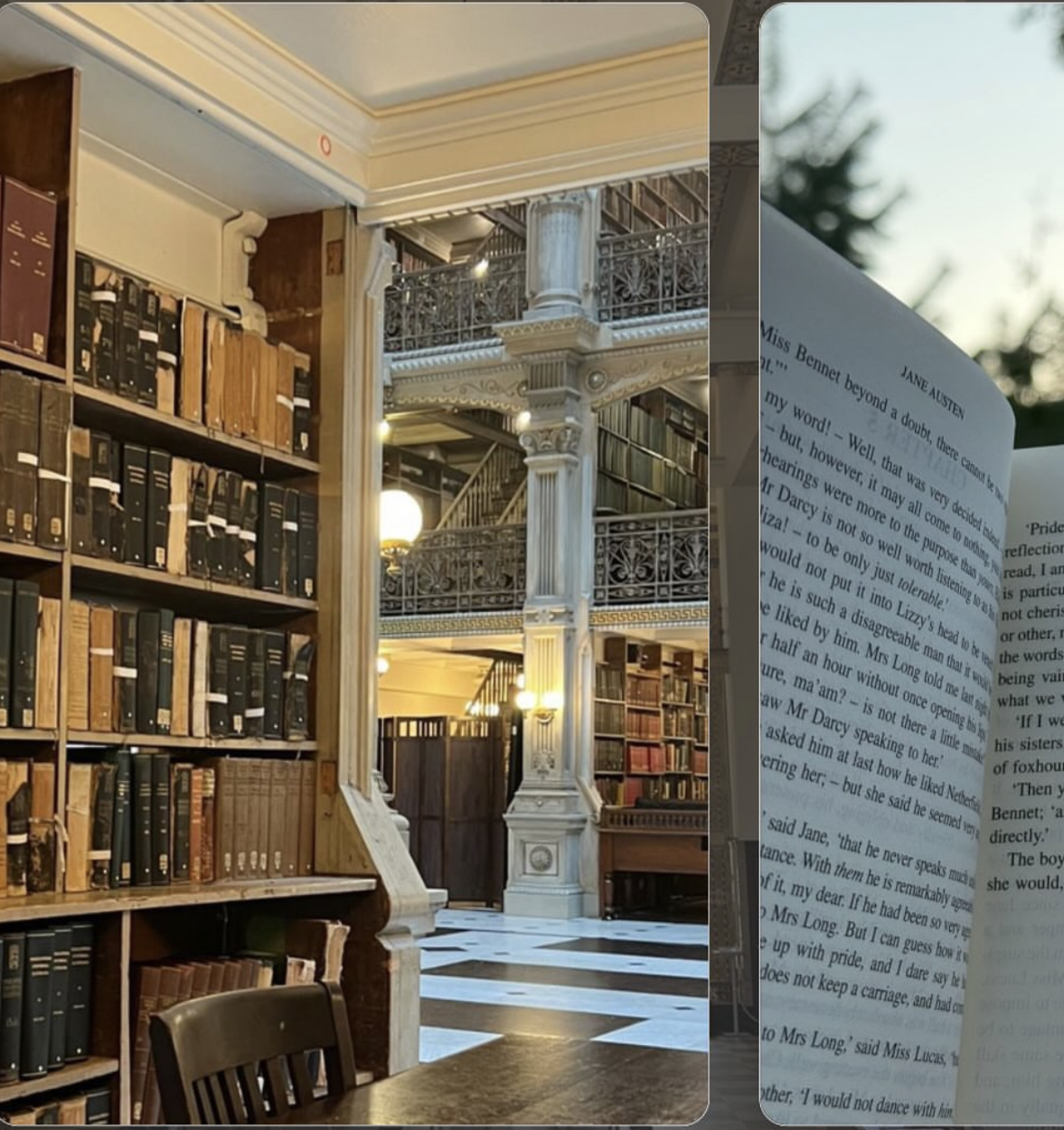
A city library is a hug.
A city library is a hug for its community.
—
It is the kind of hug that asks nothing from you except your presence. Somewhere between the turning of pages, the tapping of keys, and the low hum of people trying to become something, there is relief and quiet assurance that we are in this process together.
At different stages, yes. But still together.
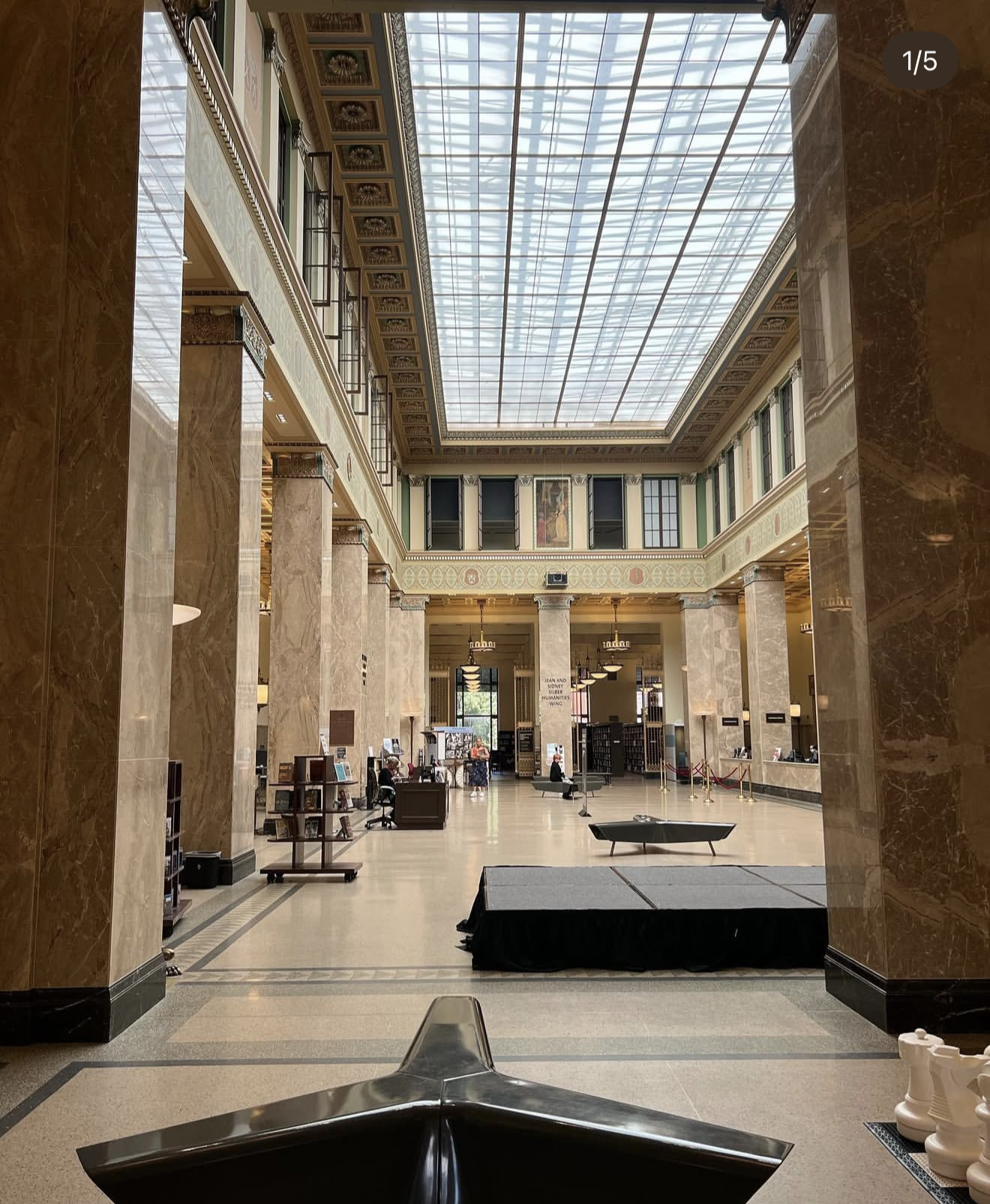
Enoch Pratt Free Library - Baltimore City Maryland (2023)
A city library is a hug for its community.
It is the kind of hug that asks nothing from you except your presence. Somewhere between the turning of pages, the tapping of keys, and the low hum of people trying to become something, there is relief and quiet assurance that we are in this process together.
At different stages, yes. But still together.
I came to cherish libraries when I moved to Baltimore City. I did not know much about Mount Vernon, but somehow it knew me. Or at least it knew what I needed: Peabody and Enoch Pratt Library. At first, it was the architecture that caught my eye, but then I noticed the people… quietly working with the shared understanding that we all came there searching. For an answer in a book. A quiet place to study. A room to host a meeting. A librarian to offer patient guidance.
Thank God for librarians. They sit at the center of all that striving, hiding, uncertainty, and curiosity, and they just hold the space until someone is brave enough to ask for help. There is something hopeful about that.
And maybe that is why I keep returning. Libraries make room for everyone at once, without being loud about it. In any corner, there are students trying to pass exams, hopeful job seekers filling out applications, neighbors escaping the cold or the heat, or someone reading simply because they still believe language can open their world a little.
I think about the people I work with whose entire lives hinge on whether the right words were written in the right order. Language as a lifeline. Libraries understand that.
In the city, where cars honk relentlessly and crowds blur your path, it is easy to become a measure of productivity. Libraries interrupt. They remind me that humans are not machines. We are thinkers and wanderers and question askers. We pause.